Luxury for Less: How to Design a Room on a Shoestring Budget
In the interior design industry, there is a concept called "The 80/20 Rule of Aesthetics." 80% of a room's visual "WOW" factor comes from just 20% of its components. This means that if you spend your money strategically on high-impact items and use clever visual tricks for the rest, you can achieve a "Designer Look" for a fraction of the cost of a traditional renovation. In 2025, budget design is no longer about "Settling for less"—it's about Strategic Selection.
RoomEnhance AI is the ultimate budget-warrior's tool. It allows you to "test-drive" expensive design choices for the price of a coffee, ensuring that every dollar you spend is a "Visual Investment" rather than a "Visual Experiment."
1. The "High-Impact Spend": Where to Put Your Dollars
If you only have $500, don't spend $50 on 10 different things. Spend $400 on one thing and $100 on the rest.
- The #1 Budget Anchor: The Large Rug. A rug defines the "Footprint" of your room. A large, high-quality rug makes everything sitting on top of it look more expensive.
- AI Strategy: Use Compose Mode to virtually "place" a 9x12 rug in your room. Notice how it "Cleans Up" the visual noise of your floor.
- The #2 Budget Anchor: Lighting. Replace your generic ceiling light with a "Statement Chandelier."
- Pro Tip: Look for "Modern Mid-Century" designs. They have complex geometries that cast interesting shadows, adding architectural value for under $150.
- The #3 Budget Anchor: Paint. One gallon of paint is $50. It can change the mood of a room more effectively than a $5,000 sofa.
2. Value Engineering: The Art of the "Lookalike"
Value Engineering is the process of finding a cheaper material that provides the same visual result.
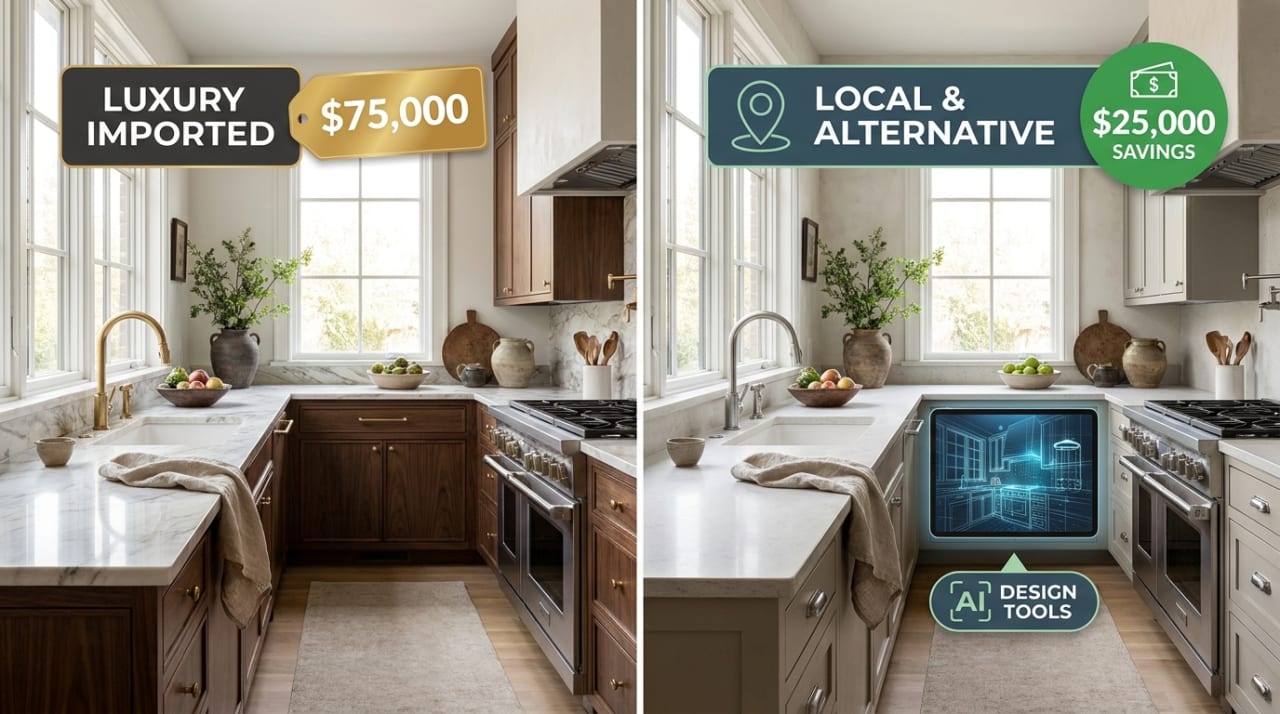
- The Marble Hack: Don't buy a $2,000 marble coffee table. Buy a $100 IKEA table and a $20 roll of "High-Fidelity Marble Contact Paper."
- AI Strategy: Use RoomEnhance to see if "White Marble" actually looks good in your lighting. If the AI render shows that the white marble is too bright, you just saved $2,000 on a mistake.
- The Hardware Swap: Spend $100 on "Solid Brass" cabinet handles for your standard kitchen. This small "Touch Point" creates a high-end sensory experience that tricks the brain into thinking the whole kitchen is custom-made.
3. The 48-Hour "No-Spend" Transformation
Before you go to the store, use the furniture you already have.
- The "Spatial Shuffle": Use Floor Plan Studio to test different layouts. Sometimes, simply pulling your sofa 6 inches away from the wall and adding a "Floating Console" behind it creates a "High-End Architectural Flow" for zero dollars.
- The Declutter Pass: 90% of "Ugly Rooms" are actually just "Busy Rooms." Use the Decluttering Studio to virtually remove the small decor items from your shelves. If the room looks better empty, it's a signal that you should "Donate, not Buy."
New Section: Expert Analysis - The "Visual ROI" of Scale
A common budget error is buying many small, cheap items (the "T.J. Maxx Trap").
- The Large Art Hack: A single 40x40 inch canvas (even a DIY one) looks 10x more expensive than a "Gallery Wall" of small frames. Large-scale art signals "Abundance" and "Confidence."
- The Full-Height Drapes: Buy 108-inch curtains instead of 84-inch ones. Hanging them at the ceiling makes the room feel grand. The cost difference is usually less than $20 per panel.
- Case Study: A user had a $300 budget for a guest room. They were going to buy new bedding and a lamp. Instead, they used RoomEnhance to visualize a "Dark Charcoal Accent Wall" and "Oversized Abstract Art." By spending $60 on paint and $150 on one large thrifted painting, they achieved a high-end "Boutique Hotel" look while keeping their old bedding.
New Section: Sourcing Second-Hand Luxury with AI
In 2025, the best designers are "Thrifters."
- The "Brand Search" Logic: On Facebook Marketplace, search for "Pottery Barn Sofa" or "West Elm Desk." These items often have "Good Bones" but might have a small stain or a scratched leg.
- The AI "Refinish" Pass: Take a photo of a thrifted item. Use Compose Mode to virtually "Paint it Black" or "Stain it Walnut." This allows you to see the "Potential" of a $50 used item before you spend your Saturday morning sanding it.
New Section: The "Touch Point" Theory
- Spend your money on things you Touch: Door handles, faucets, and throw blankets.
- Save your money on things you only See: Wall art, rugs (if they are durable), and light fixtures.
- AI Implementation: Use Compose Mode to virtually "Swap" your faucet. Notice how the polished chrome "Glint" adds a layer of visual cleanliness to the entire render.
New Section: Troubleshooting the "Budget Look"
- The "Matchy-Matchy" Trap: If your sofa, rug, and walls are all the same shade of gray, the room looks cheap. Use AI to find a "High-Contrast" accent color (e.g., add one Burnt Orange pillow).
- Hidden Wires: Spend $15 on a cable management box. Removing the "Black Tangled Mess" from your floor is the fastest way to make a $300 TV setup look like a $3,000 built-in.
- Greenery: If the room feels "Dead," add a plant. A $20 snake plant from a grocery store adds "Life" and "Organic Texture" that plastic decor cannot replicate.
Verdict: The Budget Success Checklist
- Focus on Scale: Large rug, Large art, Large light.
- Value Engineer: Contact paper and paint are your best friends.
- Standardize the Hardware: Match your metals.
- Clean the Flow: Move the furniture away from the walls.